Dholera Real Estate Investment for NRIs – Full Guide 2026
Everything Non-Residents (NRIs and OCI holders) living outside India should know about investing in real estate in Dholera Special Investment Region
If you live outside India as a non-resident and interested in Indian real estate, chances are you’ve come across Dholera more than once.
Some people talk about it as India’s next big planned city. Others warn that it is still mostly empty and far from ready. For NRIs and OCI holders, this mixed messaging creates confusion, especially when decisions have to be made from thousands of kilometers away.
This guide is written specifically for non-residents who are legally eligible to invest in Indian real estate — mainly NRIs and OCI holders.
It is not promotional. It is not anti-investment either.
The goal here is simple:
- Explain what Dholera actually is
- Separate current reality from future plans
- Highlight what changes when you invest from outside India
- Help you judge whether Dholera fits your situation or not
If you are looking for quick returns or guaranteed outcomes, this article will probably disappoint you.
If you want clarity before committing money from abroad, it will save you time and mistakes.
What is Dholera Special Investment Region (SIR)?
Dholera is officially known as the Dholera Special Investment Region, often referred to as DSIR.
A Special Investment Region is not the same as a regular city that grows gradually over decades. It is a large, pre-planned zone, where land use, infrastructure, and development phases are decided in advance.
In practical terms, this means:
- Roads, utilities, drainage, and power systems are planned first
- Land is divided into industrial, commercial, and residential zones
- Population growth is expected to come later, after economic activity starts
Dholera is backed by both the Government of India and the Government of Gujarat. This backing mainly relates to:
- Planning authority
- Infrastructure funding
- Policy support
It does not mean guaranteed timelines or assured price growth.
You will often see Dholera described as a “smart city.” In this context, the term mostly refers to:
- Centralized infrastructure planning
- Underground utilities
- Wide road networks
- Long-term capacity design
It does not mean the city is already active, crowded, or commercially vibrant.
For NRIs and OCI holders, understanding this difference early is critical, because expectations formed online often do not match on-ground reality.
What does SIR mean, and why Dholera is classified as one
Dholera is officially classified as a Special Investment Region (SIR) under Gujarat state law.
An SIR is not just a branding term. It is a legal and planning framework used to develop very large regions with a long-term economic purpose.
In simple terms, a Special Investment Region:
- Covers a very large land area
- Is planned decades in advance
- Focuses on industrial and economic activity first
- Has separate planning, zoning, and development rules
This is different from:
- A normal city expansion
- A private township
- A residential real estate project
Because Dholera is an SIR:
- Infrastructure is planned at scale
- Development happens in phases
- Residential growth is expected to follow jobs, not precede them
For NRIs and OCI holders, this classification matters because it explains why progress feels slow, and why outcomes depend more on industrial uptake than marketing timelines.
Understanding SIR helps set the right expectations early.
Where is Dholera located?
Dholera is located in Gujarat, southwest of Ahmedabad. On a map, it sits close enough to a major city to benefit from future spillover, yet far enough to allow large, planned development that is difficult inside crowded urban limits.
Here is the location map:
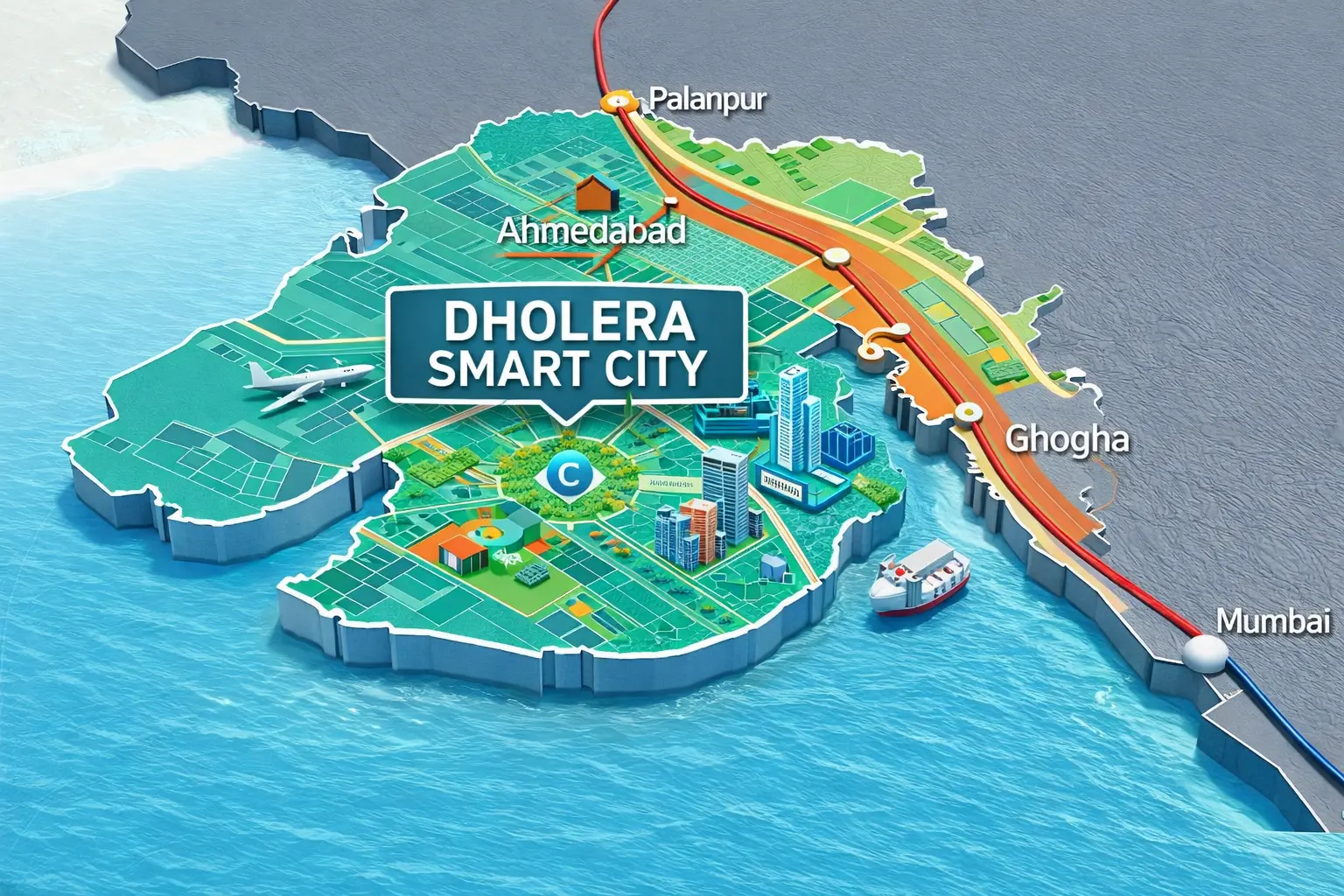
From a long-term planning point of view, this location supports:
- Industrial and logistics corridors
- Freight movement and large-scale manufacturing
- Future airport, port, and expressway links
- Expansion without the pressure of existing congestion
This kind of location is often chosen for projects that are built in phases, not overnight.
How location plays out for Non-Resident Investors
When you live outside India, location is experienced differently — but not always negatively.
For non-residents:
- You don’t visit often, so decisions are based on documents, plans, and verified updates
- Progress is tracked in milestones, not daily activity
- Patience becomes part of the investment strategy
This distance is exactly why many NRIs look at Dholera as a long-horizon opportunity, rather than a short-term trade.
Planned connectivity vs current access
Connectivity around Dholera is discussed in terms of expressways, freight corridors, ports, and a proposed international airport. Some elements are operational today, while others are moving forward in phases.
This gap between current usability and future access is common in government-led industrial regions. For investors who understand timelines, this gap is also where pricing differences usually exist.
Why this still attracts long-term NRI investors
Distance doesn’t change facts — but it does change how you think.
Many NRIs are comfortable with:
- Longer holding periods
- Gradual infrastructure rollouts
- Waiting for industrial activity to mature
For them, location is not about today’s convenience. It’s about where large-scale development is allowed to grow over time.
That’s why Dholera tends to appeal to NRIs who value structure, patience, and entry timing — and not to those seeking quick visibility or immediate returns.
Key features of Dholera Smart City
Below is a brief, easy-to-read list based on official planning and widely reported features of the Dholera Special Investment Region (SIR). This is meant to help readers see what the project plans to offer, not to make guarantees.
✔ Planned, world-class infrastructure
Dholera is a planned greenfield smart city with trunk infrastructure already underway, including roads, utilities, and zones for industry and housing. Early development in the activation area has completed much of the basic infrastructure.
✔ Ease of governance and structured planning
A dedicated authority manages land use and approvals through a single framework, aiming to reduce delays and overlapping permits.
✔ Plug-and-play approach for business
Industrial and commercial zones are designed to support faster setup for companies once core infrastructure is in place.
✔ Social infrastructure included in plans
The city plan allocates space for schools, healthcare, community facilities, and residential neighbourhoods as part of long-term development.
✔ External connectivity to major hubs
Planned expressways, freight routes, and the Ahmedabad–Dholera Expressway are set to improve access to Ahmedabad and connections across the region.
✔ Internal connectivity and layout
The smart city plan maps a grid of internal roads and utility corridors to support residential, commercial, and industrial movement.
✔ Live, work, and play concept
Residential areas, job centres, and daily services are planned in proximity to encourage balanced urban living.
✔ Sustainability focus
Large-scale solar projects and renewable energy planning (such as Dholera Solar Park) support lower environmental impact and future energy needs.
✔ Ease of doing business
Policies under the Special Investment Region framework aim to offer business-friendly conditions and streamlined regulatory processes.
✔ Security and long-term planning
City design incorporates safety, zoning norms, and planned utilities, which can support future operational stability once expansion continues.
These points reflect planned features and strategic elements of Dholera SIR as presented by official sources and major reporting. They provide context for why the project is discussed among long-term investors and industry watchers, though development timelines vary widely.
Why Dholera Project was created?
Dholera was not planned as a residential project that later tried to attract jobs.
It was planned the other way around.
The core idea behind Dholera is industrial and economic expansion.
Large governments create regions like this when:
- Existing cities become crowded and expensive
- Industries need large, contiguous land parcels
- Logistics and freight movement need space
- Long-term manufacturing growth is expected
Dholera fits into this long-horizon thinking.
The expectation is that:
- Industrial activity creates employment
- Employment brings population
- Population creates demand for housing, services, and commerce
This sequence is important.
Many real estate advertisements reverse this logic and make it look like residential demand appears first. In reality, large planned regions move at the pace of policy, infrastructure funding, and industrial uptake.
For NRIs and OCI holders, this matters because:
- Industrial timelines are slow
- Progress is uneven
- Value creation depends on actual usage, not announcements
If you evaluate Dholera as a short-term residential play, it often looks disappointing.
If you evaluate it as a long-term economic region, the picture becomes clearer — though still not risk-free.
Who Should Invest In Dholera (and who should be cautious)
Dholera is not designed for every type of investor.
It tends to make more sense for:
- People comfortable with long holding periods
- Buyers who understand early-stage region risk
- Those linking investment decisions to long-term infrastructure growth
It is usually not suitable for:
- Anyone expecting quick resale
- Buyers depending on near-term rental income
- People who cannot tolerate delays or uncertainty
For NRIs and OCI holders, suitability matters even more.
Living outside India means:
- Less control over verification
- Slower reaction time if issues arise
- Higher dependence on intermediaries
If the nature of the project does not match your patience level, distance makes the mismatch more stressful.
Being honest about fit upfront avoids regret later.
Current development status Of Dholera
One of the biggest sources of confusion around Dholera is the difference between current status and future plans.
Today, development includes:
- Major road grids
- Utility corridors
- Drainage systems
- Power and water infrastructure groundwork
- Clearly demarcated zones
At the same time:
- Population density is low
- Commercial activity is limited
- Large areas remain vacant
Future plans often discussed include:
- Expanded industrial operations
- Improved transport connectivity
- Increased residential demand
- Supporting social infrastructure
This phased approach is common in large government-backed regions. Development does not happen evenly or quickly, even when intent and funding exist.
For non-residents, this gap can feel uncomfortable because progress is measured through updates rather than lived experience. Photos and videos can show activity in one pocket while nearby areas remain unchanged.
This is why relying only on timelines given during sales conversations can be misleading.
Types of properties available in Dholera City
Property in Dholera is broadly divided into categories, each with very different risk and usability profiles.
Residential plots
- Mostly vacant land parcels
- Intended for future housing development
- Not always suitable for immediate construction
Commercial plots
- Meant for offices, retail, or mixed-use activity
- Demand depends heavily on population growth
Industrial land
- Allocated for manufacturing and logistics
- Often tied to regulatory and operational conditions
Agricultural land
- Subject to strict rules
- Generally not eligible for purchase by NRIs or OCI holders
One important point for overseas buyers:
A “plot” does not automatically mean immediate usability. Zoning, approvals, and surrounding development all affect how and when land can actually be used.
What Categories Of Non-Residents are legally allowed to buy in Dholera
Indian law clearly defines what non-residents can and cannot purchase.
In general:
- NRIs and OCI card holders can buy residential and commercial property in India
- Agricultural land, plantation property, and farmhouses are restricted
These rules apply to Dholera as well.
Key points for non-residents:
- Eligibility depends on residency status, not marketing claims
- Payment must follow prescribed channels
- Ownership rights exist, but usage may be subject to zoning
Many misunderstandings arise because sales conversations mix legal eligibility with future potential. These are not the same thing.
Before proceeding, it is important to separate:
- What is legally permitted
- What is practically usable
- What is being projected
Download the official Dholera project brochure
You can download the government brochure here to read the full details about the Dholera Special Investment Region project:
👉 https://www.nsws.gov.in/s3fs/2022-06/DHOLERA%20Brochure.pdf
This brochure gives you the official overview, planning details, and development features straight from the government source, so you can get accurate and clear information before you decide anything.
Inside the brochure you’ll find:
- Overview of the Dholera Special Investment Region and its purpose
- Map and planning approach for the region
- Key zones and development areas included in the plan
Use this to understand the official plan better before you look at listings, agents, or investment options.
How to invest in Dholera as an NRI?
If you are sitting outside India and planning to buy property in Dholera, follow these steps in the same order. This keeps the process clean, legal, and under your control.
Step 1: Confirm your eligibility & Arrange documents
First, confirm your residency status as an NRI or OCI holder.
NRIs and OCI holders are allowed to buy residential and commercial property in India. Agricultural land, plantation land, and farmhouses are not allowed. You would also need to arrange some basic documents like: Passport copy, stamped visa (in case of an NRI) and OCI copies if you are an overseas citizen of India, and an NRI PAN card.
Step 2: Decide the property type
Be clear on what you want to buy.
- Residential plot or home
- Commercial plot, office, or shop
Do not proceed unless the property type matches what NRIs and OCI holders are legally allowed to own.
Step 3: Verify land status and zoning
Before paying anything, confirm:
- The land is non-agricultural (NA)
- The zoning permits residential or commercial use
- The plot or unit falls under approved Dholera planning rules
- Title and ownership records are clear
Never rely only on brochures or verbal claims.
Step 4: Choose representation in India
Since you are abroad, appoint a trusted representative in India.
This is usually done through a Power of Attorney, signed and notarised as per rules. Your representative handles site visits, paperwork, and registrations on your behalf.
Step 5: Execute agreements and documents
Get all documents drafted and reviewed properly:
- Agreement to sell
- Sale deed
- Title and approval papers
Your representative can sign locally if the Power of Attorney allows it.
Step 6: Make payment through permitted channels
Payments must come only through allowed NRI banking routes:
- NRE or NRO account
- FCNR account
- Direct inward remittance to India
Cash payments or unofficial routes can create legal and tax issues later.
Step 7: Register the property and confirm ownership
The final step is property registration at the local sub-registrar office.
Once registered, the property is legally in your name. Keep copies of all documents safely for future use or resale.
Following these steps helps you move from decision to ownership without confusion, even when you are not physically in India.
Documents involved for NRIs investing in Dholera
If you are investing in Dholera from outside India, paperwork is a big part of the process. The good news is that most documents are standard. Below is a simple checklist to help you stay organised, without legal language.
Personal documents you will need
- Passport – Valid Indian passport (for NRIs) or foreign passport
- OCI card – Required only if you are an OCI holder
- PAN card – Mandatory for property purchase and tax records
- Overseas address proof – Utility bill, bank statement, or driving licence
- Photographs – Passport-size photos as required
Banking-related documents
- NRE or NRO bank account details
- Proof of inward remittance or account statement for payments
- Bank confirmation if funds are routed from abroad
Power of Attorney (if used)
If you are not travelling to India:
- Power of Attorney (PoA) authorising a trusted person
- Signed by you abroad
- Notarised and attested as per rules
- Used by your representative in India to sign and register documents
Property-related documents
These come from the seller or developer and must be checked carefully:
- Title documents and ownership proof
- Land zoning and approval papers
- Allotment letter or offer letter (if applicable)
- Approved layout or planning documents
Sale agreement and registration papers
- Agreement to sell
- Sale deed
- Stamp duty and registration receipts
- Registered ownership record
These confirm that the property is legally in your name.
What is usually done abroad
- Signing the Power of Attorney (if required)
- Sending identity and address documents
- Making payments through approved banking channels
What is usually done in India
- Property verification and site checks
- Execution of sale agreement and sale deed
- Property registration at the local office
- Collection and storage of registered documents
Keeping this paperwork complete and organised makes future resale, tax filing, and repatriation much easier.
Power of Attorney, registration, and remote ownership explained
When you invest in Dholera from outside India, you may not be physically present for every step. This is where a Power of Attorney (PoA) and proper registration become important.
When a Power of Attorney is needed
A PoA is usually required when:
- You cannot travel to India for signing
- Documents need to be executed locally
- Property registration must be completed on your behalf
If you plan to visit India and sign everything yourself, a PoA may not be needed.
Who should be appointed as your PoA holder
Choose carefully. This person acts in your name.
- A close family member you trust
- A lawyer with clear written limits
- Someone who understands paperwork and timelines
Always appoint one person, not multiple people.
Risks of a broad Power of Attorney
A common mistake is giving too much authority.
- Broad PoA can allow misuse
- It may permit resale or changes without your consent
- Revoking it later can be difficult
Limit the PoA strictly to:
- One specific property
- Defined actions only (signing, registration, submission)
How registration works when the buyer is abroad
The usual flow is:
- You sign and notarise the PoA abroad
- The PoA is sent to India and stamped if required
- Your PoA holder signs the sale deed in India
- Property is registered in your name at the local office
Your physical absence does not reduce legal validity if this is done correctly.
What ownership really means when you are not present
Even if you never visit the site:
- The property is legally in your name
- You have full ownership rights
- Responsibilities like taxes and compliance remain yours
Remote ownership works well when documentation is clean and authority is limited. This keeps you protected even when managing everything from abroad.
Applicable NRI Taxation For Investing In Dholera
Before you invest in India’s promising real estate project Dholera, it’s important to understand how taxes apply at different stages. This section is only to explain how things generally work, not to give tax advice. Knowing this early helps you avoid surprises later.
At the buying stage
When you buy property in India as an NRI or OCI holder, tax rules already come into play.
- TDS may apply on purchase if you are buying from a resident seller and the value crosses the applicable limit
- In some cases, the buyer is required to deduct TDS and deposit it with the government
- Stamp duty and registration charges are paid separately and are not part of TDS
Missing TDS compliance can create problems even years later.
During the holding stage
If you hold the property for some time:
- There is no tax just for holding property
- If the property is rented out, rental income becomes taxable in India
- Property tax paid to the local authority may apply depending on the location
Keeping yearly records helps if you plan to sell later.
At the selling stage
Taxes matter most when you sell.
- Capital gains tax applies on profit from sale
- If sold within a short holding period, it is treated as short-term capital gains
- If held longer, it may qualify as long-term capital gains, which is taxed differently
- TDS is usually deducted by the buyer at the time of sale when the seller is an NRI or OCI holder
This is where most NRIs face confusion if paperwork is weak.
Repatriation considerations
If you plan to take money back outside India:
- Repatriation is allowed within limits and subject to conditions
- Proper tax payment proof and banking records are required
- Sale proceeds usually need to pass through NRO or NRE accounts
Without proper compliance, funds can get stuck.
Why clean paperwork matters later
Many tax issues don’t show up at the time of purchase. They appear when you sell or repatriate money.
- Clean agreements help calculate capital gains correctly
- Proper payment records support repatriation
- Clear ownership documents reduce disputes and delays
Good paperwork today saves stress, time, and money in the future.
Price Expectations: A reality check for NRIs and OCI holders
One of the strongest attractions of Dholera is pricing.
Land prices are lower than in developed urban centers, but lower price alone does not mean faster growth.
For non-residents, it helps to think in terms of:
- Long holding periods
- Gradual value creation
- Demand driven by actual usage
Prices tend to move meaningfully when:
- Industrial activity increases
- Employment rises
- Population starts settling
Announcements and plans may influence sentiment, but sustained movement usually follows real activity.
If your expectations are short-term, Dholera may feel slow. If your expectations are aligned with long-term development cycles, it may feel more reasonable.
Risks to consider while investing in Dholera as a Non-Resident
All real estate carries risk. Distance increases certain risks.
For NRIs and OCI holders, the most common ones include:
- Delays in development timelines
- Over-dependence on intermediaries
- Misleading possession or readiness claims
- Limited exit options in early stages
- Difficulty in on-ground verification
These risks are not unique to Dholera, but early-stage regions amplify them.
Being aware of these risks does not mean avoiding investment. It means adjusting expectations and doing deeper checks.
Choosing real estate agents or developers as an NRI to buy property in Dholera
When you live outside India as an NRI, you don’t see the property, the people, or the paperwork in real time. That gap makes agent or developer selection very important. One wrong choice can cost you money, time, and peace of mind.
How NRIs should evaluate agents or developers
Start with basics. Don’t get impressed by talk or photos.
- Check how long they have been active in the same city
- Ask for verifiable past transactions, not screenshots
- Confirm they work on written terms, not WhatsApp promises
- Make sure payments, commissions, and scope are clearly written
- Prefer people who are comfortable with lawyers and paperwork
If someone avoids documents or rushes you, that’s already a sign.
Common red flags you should not ignore
These are warning signs many NRIs miss:
- “This deal is only valid today” pressure
- Asking for advance money before sharing documents
- Refusing to share draft agreement copies
- Saying “trust me, this is standard” without proof
- Asking you to sign without explaining clauses
If it feels uncomfortable, stop. Distance makes mistakes expensive.
Questions you must ask before moving ahead
Ask clearly. A genuine professional won’t mind.
- Who represents my interest in this deal?
- What is your exact role — agent, mediator, or marketer?
- How and when do you get paid?
- Who handles legal checks and registrations?
- What happens if the deal falls through?
If answers keep changing, walk away.
Why over-dependence is risky for NRIs
Many NRIs hand over full control because they are busy or abroad. That’s risky.
- Agents may push what benefits them, not you
- Developers may delay or change terms later
- Verbal assurances have no legal value
- You lose control over timelines and decisions
Your name, your money, your responsibility — even if someone else handles the work.
Why this approach protects you
When you ask questions, keep records, and avoid blind trust:
- You reduce legal risk
- You avoid payment disputes
- You stay in control even from abroad
- You build a clean paper trail
This is not about distrust. It’s about being smart when you are not physically present.
RERA-Registered Residential Projects in Dholera (Gujarat)
Dholera is still in an early-stage real estate cycle, so the number of proper RERA-registered residential projects (with construction plans) is limited. Also, recent policy changes suggest that plot-only schemes may not qualify for RERA anymore, so focus should be on villa/township-based developments.
Below is a verified and curated list of currently known RERA-linked or RERA-listed residential projects in Dholera. I’ve added contextual links so readers can check details directly.
✅ Active / Listed RERA Projects
- Seksaria Shantiban Dreams – by Seksaria Group
- Apartments (1 & 2 BHK)
- Possession: Dec 2028
- Greenera Gardenvilla Phase 1 – by Greenera Infrawell Pvt. Ltd.
- Villas / plotted + construction concept
- Possession: Dec 2029
- Cube Nest 29 – by Cube Infra
- Residential plots (earlier RERA-listed phase)
- Cube Nest 63 – by Cube Infra
- Residential plotted township
- Possession: 2025
- Fidato Luxuria 2 – by Fidato Buildcon
- Residential plots / township format
- Possession: 2024
- Aaiji Residency 477 – by Aaiji Group
- Premium residential plots (TP-2 zone)
- Infinity Park View – by Infinity Infra
- Residential plotted development
- Dholera Megacity 771 – by Dholera Megacity Developers
- Residential plots
- Possession: ~2025
- Greenera Prime 2 – by Greenera Infrawell Pvt. Ltd.
- Residential plots
- Chhabildas Dholera Sky – by Chhabildas Developers Pvt. Ltd.
- Mixed residential development
🏡 Additional RERA-Linked / Builder-Listed Projects
(These appear in RERA listings or developer disclosures but require verification on GujRERA portal)
- Piccadilly Square II – township-style plotted + villa project
- Dholera Megacity Iris – by Infinity Infracon
- Piccadilly Square 2 (Smart Homes Infra) – TP1 location, villa + plots
- Dholera Lakeside Residency – plotted project near smart city zone
⚠️ Important Note for NRIs
- Many “Dholera projects” you see online are plot-only schemes, and not all are RERA-compliant anymore.
- Always verify using the official Gujarat RERA portal before investing.
- Prefer:
- Villa/township projects (higher compliance)
- TP1 / TP2 zones inside SIR
- Developers with actual execution history
Safe vs High-Risk RERA Projects in Dholera (NRI Investment View)
Not all RERA projects in Dholera are equal. For NRIs, what really matters is whether there is actual construction, proper township planning, and a known developer. Many projects are still plot-based, which increases risk.
Here’s a simple classification to help you understand:
| Project / Developer | Type | Assessment | Reason |
|---|---|---|---|
| Seksaria Shantiban Dreams | Apartments | ✅ Safer | Real construction project, better usability |
| Greenera Gardenvilla Phase 1 | Villa + Plots | ✅ Safer | Township model, more structured development |
| Greenera Prime 1 & 2 | Plots | ⚠️ Medium | RERA listed but mainly plotted scheme |
| Cube Nest 29 / 63 | Plots | ⚠️ Medium | Clear documents, but plot-heavy model |
| Fidato Luxuria 2 | Plots | ⚠️ Medium | Limited visible construction progress |
| Aaiji Residency 477 | Plots | ⚠️ Medium | Early-stage development |
| Dholera Megacity 771 | Plots | ⚠️ Medium | Depends on long-term execution |
| Small / Unknown Developers | Plots | ❌ Higher Risk | Marketing-heavy, weak execution history |
Quick Take For Non-Residents
- Safer: Apartment or villa-based projects
- Medium: RERA-approved plotted projects
- Higher Risk: Unknown developers selling only plots
Disclaimer: This is our personal assessment based on available data and market understanding. It may or may not be fully accurate. This is not official information from any government authority or RERA body. Always verify independently before investing.
Upcoming Industries In Dholera
Dholera Special Investment Region is planned as an industrial-led city, with residential and commercial areas growing around employment zones. Official planning documents and government material consistently point to the following industry categories.
These are intended focus sectors, not guarantees of timelines or scale.
Core industry segments identified for Dholera
- Defence and aerospace manufacturing
Planned for large land parcels, testing facilities, and long-term manufacturing setups that need distance from dense cities. - Aviation and aircraft-related services
Linked to the proposed airport ecosystem, including maintenance, components, and support services over time. - Electronics and semiconductor-related manufacturing
Clean manufacturing zones aimed at electronics assembly, components, and allied supply chains. - High-tech and emerging technologies
Includes advanced manufacturing, automation-led units, and technology-driven industrial activity. - Heavy engineering
Large-scale fabrication, machinery, and infrastructure-related manufacturing that requires planned utilities and transport access. - Pharmaceuticals and biotechnology
Non-polluting pharma units, research-linked facilities, and controlled manufacturing zones. - Automobile and auto-ancillary units
Component manufacturing and supplier ecosystems rather than finished vehicle plants. - General manufacturing
Small to mid-sized manufacturing units supporting broader industrial supply chains. - Agro and food processing
Processing, storage, and value-add units linked to regional agricultural output. - Metals and metallurgical products
Downstream metal processing rather than heavy smelting, aligned with non-polluting norms.
Why this matters for real estate investors
Dholera’s real estate logic is industry first, housing later.
These sectors are land-intensive, slow to build, and long-term by nature.
For NRIs, this explains:
- Why development takes time
- Why early prices remain lower
- Why demand is expected to grow in phases, not suddenly
The presence of planned industries does not mean immediate activity — but it does explain why the city is structured the way it is.
Common misunderstandings about Dholera
Because Dholera is discussed widely online, many ideas around it get repeated without context. Clearing these up helps NRIs and Overseas Citizenship of India (OCI) card holders judge it more calmly.
“Dholera is already a fully developed city”
Dholera is planned and partially developed, not fully active. Core infrastructure exists in phases, but population and commercial activity are still limited.
“Everything is guaranteed because it’s a government project”
Government backing supports planning and infrastructure. It does not guarantee timelines, demand, or returns.
“Prices will rise quickly once the airport opens”
Large infrastructure projects influence long-term demand. They do not always lead to immediate price movement.
“If land is registered, it’s ready to use”
Registration confirms ownership. It does not mean construction or usage can start immediately.
“Dholera is the same as past failed projects”
Every region has a different planning model. Comparisons without understanding structure, scale, and intent often miss important differences.
Questions NRIs and OCI holders commonly ask about Dholera
Is Dholera officially approved by the Indian government?
Yes. Dholera is a notified Special Investment Region with backing from central and state authorities.
Can NRIs and OCI holders buy property in Dholera?
Yes, residential and commercial property can be purchased. Agricultural land and farmhouses are restricted.
Is it safe to invest without visiting the site?
It can be done, but distance increases reliance on documents, representatives, and verification. Caution matters more.
Is Dholera developed enough for rental income?
At present, rental demand is limited. Most buyers consider it a long-term holding rather than an income property.
How long before real demand builds up?
Demand usually follows industrial activity, employment, and population movement. This tends to happen gradually, not suddenly.
Is Dholera suitable for short-term resale?
Generally, no. Early-stage regions are not ideal for quick exits.
Dholera compared with other smart or planned cities in India
Dholera is often grouped together with other smart cities or planned urban projects in India. While comparisons are natural, they can also be misleading if the underlying models are not understood.
Here is a high-level comparison, focused on structure rather than names.
Planning approach
- Dholera Special Investment Region
Planned as a large industrial and economic region, with residential demand expected to follow employment and infrastructure. - Many smart city projects
Often focus on upgrading existing cities with better services, technology, and governance.
Development timeline
- Dholera
Long-term, phase-based development measured in decades rather than years. - Other planned cities
Often show faster visible activity because population already exists or development is smaller in scale.
Population and demand
- Dholera
Low population today. Demand is expected to grow gradually as industrial activity increases. - Other urban projects
Usually benefit from existing population, rentals, and commercial usage.
Risk profile for NRIs and OCI holders
- Dholera
Higher patience required. Outcomes depend on policy execution and economic activity. - More mature locations
Lower uncertainty, but also higher entry prices and limited long-term upside.
Why comparisons often confuse overseas buyers
People living outside India often compare Dholera to places that already have:
- Dense population
- Active rental markets
- Established commercial zones
Dholera does not operate on that model.
It is closer to an economic region under creation than a ready urban neighborhood. Comparing it to mature cities without adjusting expectations leads to wrong conclusions — both positive and negative.
Future potential of Dholera: Why NRIs still consider it despite slow progress
Here’s a clear, short look at why some NRIs keep watching or buying in Dholera — and why others walk away. No hype, no guesses — just facts and practical points
Dholera is a planned industrial city backed by state and central agencies, and official materials and updates are available from the government.
- Industrial planning logic: Dholera is part of the larger Delhi–Mumbai Industrial Corridor and is designed to develop industrial zones first, then supporting housing and services. This staged plan is why some buyers expect jobs and demand to follow infrastructure.
- Time horizon: Expect a long lead time — most realistic plans assume a 10–20 year horizon for major benefits to appear. Look for concrete milestones (activation-area works, airport, expressway links) rather than marketing claims.
- Why price gaps exist: Land and housing are cheaper now because demand is low and many projects are still in early phases. That gap is what attracts some long-term buyers.
- Why some NRIs wait: They can accept long holding periods, prefer early entry prices, and want exposure to industrial growth that may emerge later.
- Why others walk away: Slow delivery, uncertainty on near-term services, and need for rental income or quick liquidity push many buyers to avoid the area.
Also to consider:
- Treat any Dholera purchase as long-term and check the exact sector/phase of the plot or unit.
- Track government milestones (official site and brochure) and reputable press reports before deciding.
- Keep paperwork clean and verify developer or allotment claims carefully; that reduces risk while you wait.
Important sources:
Recent reporting and analysis: Indian Express and Times of India coverage.
Government brochure: https://www.nsws.gov.in/s3fs/2022-06/DHOLERA%20Brochure.pdf.
Dholera official site: https://dholera.gujarat.gov.in/.
Is Dholera suitable for NRIs and OCI holders?
Dholera may make sense if you:
- Are comfortable with long timelines
- Understand early-stage region risk
- Do not rely on short-term returns
- Are prepared to verify things carefully from abroad
It may not suit you if you:
- Expect fast appreciation
- Need steady rental income
- Prefer mature, active neighborhoods
- Are uncomfortable with uncertainty
There is no universal right answer. Suitability depends on expectations, patience, and risk tolerance.
To summarize
Dholera is a long-term planning story, not a quick result story.
For non residents Indians and OCI card holders, the key points to remember are:
- It is infrastructure-led, not demand-led
- Progress happens in phases
- Distance magnifies both risk and misunderstanding
- Legal eligibility does not equal practical readiness
If you approach Dholera with patience, clear verification, and realistic expectations, it becomes easier to evaluate calmly.
If you approach it with urgency or assumptions, it often leads to disappointment.
The goal is not to rush a decision, but to make an informed one — especially when that decision is being made from outside India.
Official sources referenced in this guide:
This guide is based on publicly available information from official Indian government and regulatory authorities. Readers are encouraged to verify details directly from these sources, as policies and project timelines may change.
Government of Gujarat – Land and Revenue Departments
State-level portals for land records, registration, and property-related compliance
https://revenuedepartment.gujarat.gov.in
Dholera Special Investment Region Development Authority (DSIRDA)
Official planning and development authority for Dholera Special Investment Region
https://dsirda.gujarat.gov.in
Delhi Mumbai Industrial Corridor Development Corporation (DMICDC)
Government body responsible for industrial corridor planning, including regions linked to Dholera
https://dmicdc.com
Reserve Bank of India (RBI)
Regulator for FEMA rules related to property purchase and fund transfers by NRIs and OCI holders
https://www.rbi.org.in
Income Tax Department of India
Official source for capital gains tax, TDS rules, PAN requirements, and tax compliance
https://www.incometax.gov.in
Disclaimer:
This article is published for general information purposes only. It is not investment advice, legal advice, or a recommendation to buy or sell any property.
Real estate rules, development timelines, and project details can change over time. While care has been taken to keep the information accurate, readers should independently verify all facts, legal eligibility, approvals, and documents before making any investment decision.
Property investments carry risk, especially when managed from outside India. NRIs and OCI holders are strongly advised to consult qualified legal, tax, and real estate professionals before committing funds.
The website and author do not accept responsibility for decisions made based on this content.